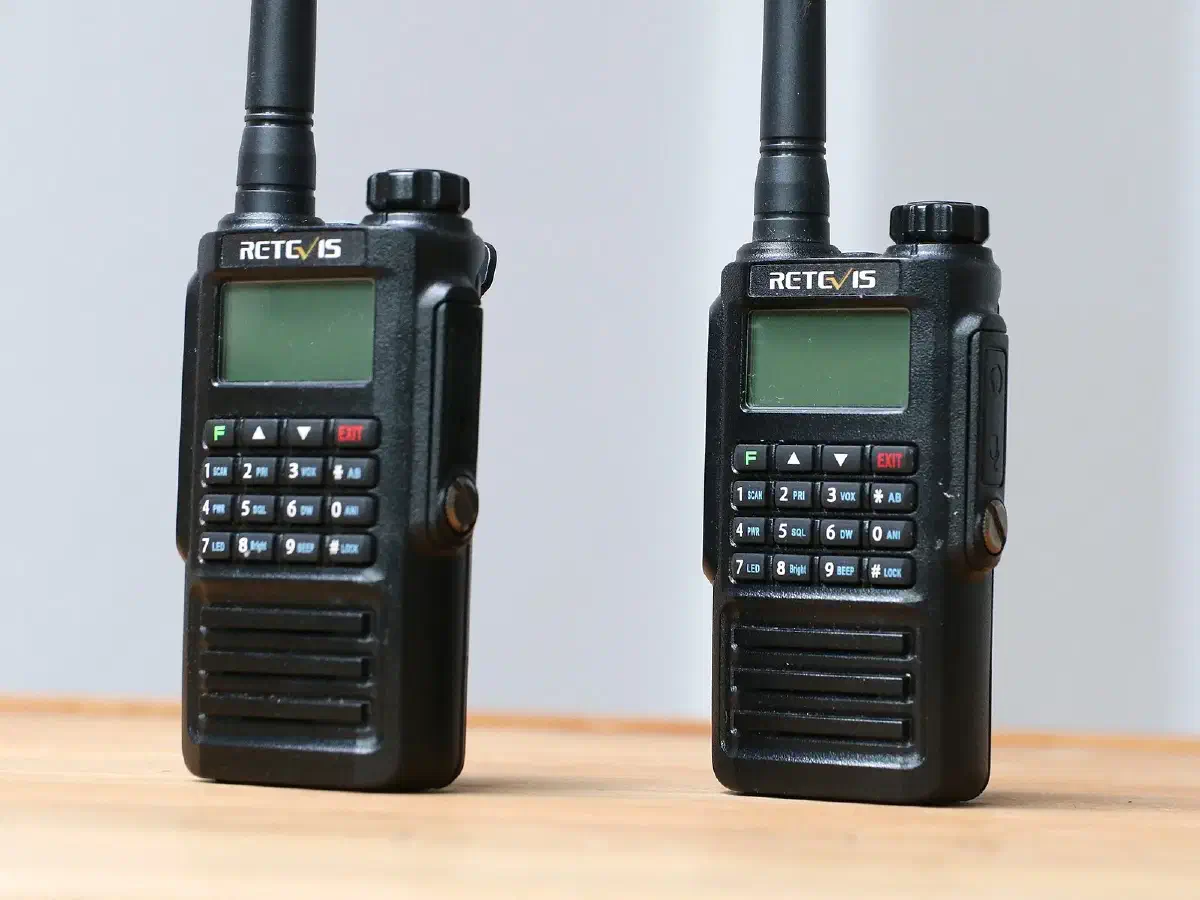
When the cell network goes down, a handheld radio is the cheapest way to keep talking to your family. It needs no tower, no subscription and no internet. It does need the right choice up front, because the wrong radio fails at the worst moment: dead battery, wrong band, or a range number that was never real.
This guide covers the radio services, what range you will actually get, battery and weather ratings, picks by budget, and how to fold radios into a household plan.
FRS, GMRS and MURS: What’s the Difference? #
Three license-light services cover most survival use.
FRS (Family Radio Service) is the blister-pack radio at the big-box store. Output is capped at 2 watts on the shared channels, and the antenna is fixed. No license is required. It is the simplest option, and the one your neighbors are most likely to own.
GMRS (General Mobile Radio Service) shares many of the same channels but allows up to 50 watts on certain channels, with detachable antennas and repeater access. In the US it requires an FCC license. The fee is modest, there is no exam, and one license covers your whole immediate family. Most handhelds sold today are GMRS/FRS hybrids, and the difference between legal and illegal use is the license, not the hardware. Handhelds usually run 2 to 5 watts.
MURS (Multi-Use Radio Service) uses five VHF channels, allows 2 watts, and needs no license. VHF travels better through trees than the UHF used by FRS and GMRS, and the band is much emptier. The downside is that radios are fewer and less common, so you will probably have to buy and set up the whole group’s radios yourself.
Which should you buy? For most households, a GMRS/FRS hybrid is the right default, plus the license. If you want a quieter channel and your group is small and committed, add MURS. Ham radio is a bigger step with far more reach. We cover that in our emergency communication devices guide.
Range: Marketing vs. Reality #
Packaging claims of 25, 30 or 50 miles come from line-of-sight tests on a mountaintop with nothing in between. You will not see that.
Rough expectations for handhelds:
- Dense neighborhood or city: a few blocks up to half a mile. Buildings eat UHF signal.
- Suburbs with trees: half a mile to a mile.
- Open country, flat terrain: one to three miles.
- Ridge to valley with clear line of sight: several miles, occasionally more.
Power helps less than people think. Going from 2 to 5 watts gives a modest gain. Height and clear air matter much more. Moving to a second-floor window, a roof, or a hilltop can double your reach for free.
Mobile and base GMRS units in a vehicle or at home, with an outside antenna, go much farther than anything in your hand. A repeater can stretch coverage across a county, if one operates near you and you are licensed to use it.
Battery Life and Power #
Look for a radio that takes both a rechargeable pack and standard AA or AAA cells. A rechargeable pack is cheaper over time and charges from USB. Alkaline backup means a drawer of batteries can keep you on the air when the grid is out and your solar charger is cloudy.
Manufacturer run times assume a 5-5-90 duty cycle: 5 percent transmit, 5 percent receive, 90 percent standby. Heavy talking drains much faster, and cold weather cuts capacity further. Plan for a working day per charge, not the quoted figure.
Keep a spare pack or fresh AAs per radio, turn radios off between check-ins, and charge them from a battery bank or solar panel.
Waterproofing and Durability #
Radios live on belts and in pack pockets. Rain, dust and drops are routine.
The IP rating tells you what you are buying. IPX4 handles splashes, which is fine for rain. IP67 survives brief submersion, roughly a meter for 30 minutes, which matters if you boat, paddle or ford streams. IP54 means dust-resistant and splash-resistant, which is adequate for most walking and household use.
Also check for a rubberized case, a sealed port cover and a sturdy belt clip. NOAA weather alerts and a built-in flashlight are worth having.
Top Picks by Budget Tier #
Specific models change every year, so choose by category and features. Check current reviews before buying.
Budget (under about $50 per pair) #
Basic FRS radios from the big names suit short range, kids and campground use. You get the standard channels, a belt clip, and usually a battery pack with an AA fallback. Expect IPX4 weather resistance at best and a short real range. Good as a starter set or a spare, not as your only plan.
Mid-range ($50 to $150 per pair) #
This is the sweet spot for most families. Look for a GMRS/FRS hybrid with a rechargeable pack and AA backup, privacy codes, NOAA alerts, a flashlight and a USB charge port. Many models in this tier are IP67 rated. They are rugged enough for daily carry and simple enough that a teenager can run one.
Premium (over $150 per radio) #
Here you get true GMRS output at 5 watts, detachable antennas, repeater support, programmable channels, and tougher housings, along with longer battery life. Radios in this class can be programmed from a computer so your whole group has the same channel list. If your group is serious about distance, spend here and add a vehicle-mounted unit.
Group Channel Protocols #
Hardware is half the job. A group that agrees on procedure gets more out of a mediocre radio than a group of strangers gets out of an expensive one.
Pick channels in advance. Choose a primary channel and one or two backups, all written down. Avoid channel 1 to 7 on FRS if you can; they are the busiest and the default for store-bought radios. Add a privacy code, but remember it only filters audio. Anyone can still hear you on that channel.
Hold radio checks. Set a time, such as the top of every hour or once at dusk, when everyone turns on and confirms. A check is quick: “Base, this is Mike, radio check.” “Mike, base, loud and clear.” That tells you who is in range and whose battery has died.
Keep it short. Say who you are calling, who you are, then the message. Release the button before you think. Skip names and locations if people outside the group might be listening.
Set a fallback. If you can’t raise anyone, go to the backup channel, then move to a known high point and try again. Decide in advance what silence for a set time means.
Assume you’re overheard. Unencrypted radio is public. For sensitive movement, use agreed code words, or see our guide on establishing secure and stealthy communication networks. And for situations where talking at all is a risk, silent communication for survival groups covers hand signals and other quiet methods.
Pairing Radios With Your Household Comms Plan #
A radio is a tool inside a plan, not the plan itself. Before you buy more gear, write down who needs to reach whom, and how.
A workable layered setup looks like this:
- Phones first. Texts often get through when calls don’t. Use them until they stop working.
- Radios for local contact. Give each adult and older child a handheld, with set channels and check-in times. Keep a base radio at home.
- Weather and news. A NOAA-capable radio or a hand-crank receiver tells you what is going on.
- Long range. Ham or a regional contact for anything beyond a few miles.
- Paper. Meeting points, phone numbers and channel lists printed and laminated in every bag.
Our walkthrough on how to build an emergency communication plan covers the steps, including out-of-area contacts and rally points. The wider communications section has more on each layer.
Practice once a quarter: kill the phones for an afternoon and see whether radio checks work. You will find dead batteries and wrong channels on a calm day.
The Short Version #
Buy a GMRS/FRS hybrid pair in the mid-range tier, get the license, and test the real range in your area. Pick channels, schedule checks, and keep batteries charged and spares on hand. Then write it all into your household plan and run a drill. A modest radio that everyone knows how to use beats an expensive one in a drawer.